






Sixties
City presents
a wide-ranging series of
articles on all aspects of the Sixties, penned by the creator of the iconic
60s music paper Mersey
Beat
|
|
|
|
|
|
|
|
Sixties
City presents
a wide-ranging series of
articles on all aspects of the Sixties, penned by the creator of the iconic
60s music paper Mersey
Beat
|
||||||
|
| Work
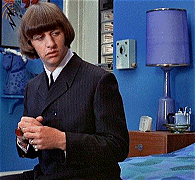
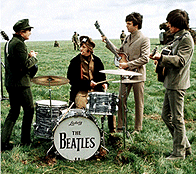
on the second Beatles movie ‘Help!’ began on 24th February 1965, with
an eleven-week shooting schedule and double the funds of their first film.
Initially, Dick Lester and Joe McGrath had written an original treatment.
According to McGrath it had been based on an old film idea: A doctor tells
Ringo that he is terminally ill. Depressed, Ringo pays £500 to a contract
killer, who is a master of disguise. As he doesn’t want to face death
directly, Ringo has asked the killer to murder him when he least expects
it. The next day the doctor informs him that there has been a mistake,
the X-rays he’d consulted had belonged to someone else, and therefore
Ringo isn’t terminally ill. Not able to contact the contract killer, he
panics and tells the other Beatles to track down the killer before he
can carry out his assignment. Lester’s recollection of that initial treatment
is slightly different. He has Ringo complaining that he can’t cope with
his stress-filled life any longer. Sitting in a bar he moans “I can’t
go on any more”. The person sitting next to him says, “If you haven’t
got the courage to put an end to it yourself, I’ll do it for a price.
I’m a professional assassin”. Ringo gives him a cheque. The next day he
wakes up and realises what he’s done and panics. This treatment was dropped when Lester discovered that a film with a virtually identical plot was already being filmed in Hong Kong. It was ‘Les Tribulations d’un Chinoise en Chine’, with Jean Paul Belmondo. Lester then contacted Marc Behm, an American writer living in Paris (who’d penned the Audrey Hepburn movie ‘Charade’), to come up with a synopsis vaguely based on the idea that Ringo was being attacked by various people and didn’t know why. |
 |
 |
Once the synopsis had been written, Lester then contacted Charles Wood,
who had penned the screenplay for Lester’s previous film, ‘The Knack’.
He felt that Behm’s story had no ‘Englishness’ to it and wanted Wood to
rewrite it to suit The Beatles and bring in a degree of ‘Englishness’.
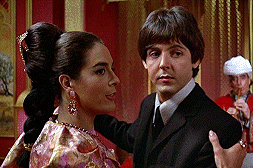
This resulted in appearances of, or references to, various British icons ranging from James Bond to the Queen, with scenes in Scotland Yard, Buckingham Palace and with the British army on Salisbury Plain. Wood completed the revised script in ten days, commenting, “It was just an assignment. I don’t think I did a particularly good job”. Bud Ornstein wasn’t too enthusiastic about it either, but he needed to get another Beatles movie off the ground. The Behm/Wood screenplay didn’t manage to capture The Beatles’ humour in the same way as Alun Owen had in ‘A Hard Day's Night’ although there are touches of Scouse wit. While watching the belly dancer Durra perform in a restaurant, the boys quip, “Doesn’t the blood rush to your stomach?” At another point in the movie, John picks up a season ticket out of his soup and says, “I’d like a bit of seasoning”. When a Scotland Yard superintendent sarcastically remarks “So you’re the famous Beatles, how long do you think you’ll last?” John replies: “And the Great Train Robbery – how do you think that’s going?” |
|
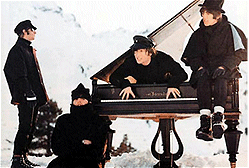
It was decided that the filming should begin in Nassau in the Bahamas
and the cast and crew of 70 flew out on 22nd February in a chartered
Boeing 707. The
temperature in the Bahamas was 90 degrees, but The Beatles couldn’t
afford to get a tan
as they would next be filming
a sequence in Austria that would be appearing prior to those shot in
the Caribbean. Cast and crew left for Austria
and the ski resort of Oberauern on 13th March. |
 |
 |
While ‘A Hard Day’s Night’ had cost only $500,000
to make, ‘Help!’ (filmed in Eastmancolor) cost $1.5 million.
This Walter Shenson-Subafilms production was once again distributed by
United Artists and directed by Dick Lester. The film begins with the tribute: “Respectfully dedicated to the memory of Elias Howe who, in 1846, invented the sewing machine”. Title cards are used at various points in the film bearing such inscriptions as ‘Intermission’ and ‘End of Intermission’: the scene in which Paul is miniaturised and dodges around the floor of his flat is heralded by a card reading ‘The Adventures of Paul on the Floor’. By the time the cameras had started rolling, an official name still hadn’t been confirmed. It was initially known as ‘Beatles Two’ and for a time called ‘Eight Arms To Hold You’. John and Paul began composing numbers for the film even before they saw the script. A total of 14 numbers were originally produced, nine of which were given to Dick Lester who selected seven for the soundtrack. |
 |
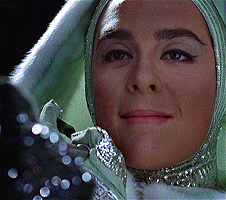 |
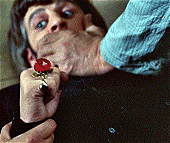
The original 14 songs were: ‘I Need You’, ‘Another Girl’, ‘Ticket To Ride’, ‘Yes It Is’, ‘The Night Before’, ‘You Like Me Too Much’, ‘Tell Me What You See’, ‘You’ve Got To Hide Your Love Away’, ‘If You’ve Got Trouble’, ‘You’re Going To Lose That Girl’, ‘That Means A Lot’, ‘Help!’, ‘I’m Down’ and ‘Wait’, ‘Yes It Is’, ‘You Like Me Too Much’, ‘Tell Me What You See’, ‘If You’ve Got Trouble’, ‘That Means A Lot’, ‘I’m Down’ and ‘Wait’ were dropped from the actual soundtrack. Other members of the cast were Leo McKern as Clang, Eleanor Bron as Ahme, John Bluthal as Bhuta, Warren Mitchell as Abdul, Peter Copely as a jeweller and Dandy Nichols as a neighbour. Bruce Lacey plays Lawn Mower (he mows a lawn – situated in a drawing room – with two pairs of false teeth) and Mal Evans pops up from time to time as a Channel swimmer who has lost his way. The official synopsis outlined the story as follows: “In the Eastern Temple of the Goddess Kali, a human sacrifice is about to be made, but the executioner, the High Priest Clang, is stopped by the beautiful Ahme, priestess of the cult, who has discovered that the victim is not wearing the sacrificial ring essential for the ritual. On the other side of the world The Beatles are performing. Ringo sits on the stage playing the drums and amongst his many rings is – the ring – a present from an unknown fan of another continent. In the days that follow a series of mysterious events make no sense to The Beatles. At home, on the street, a strange force seems to be directed at Ringo. A gang of thugs descend upon the boys and attempt to amputate Ringo’s entire hand – and The Beatles realise that it is Ringo’s new ring they must have! |
| After
several more attempts, Clang and his gang nearly succeed in stealing Ringo’s
whole person, but just in time he is saved by Ahme. A few days later,
while the boys are waiting for a meal in an Indian restaurant, the dreaded
Clang and his henchman Bhuta appear disguised as waiters. They tell Ringo
that since they cannot remove the ring from his finger he is to be sacrificed
to the goddess. The boys flee to the nearest jewellers and ask the man
to cut off the offending ring, but the metal breaks the files and the
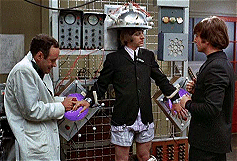
cutting wheel. The boys call next at a science laboratory run by Professor
Foot and his assistant Algernon who put Ringo through every machine they
have – to no avail; the ring resists all the assaults known to science.
Foot decides that the ring has properties which could give the owner the
power to rule the world, and he confides to Algernon that he must get
the ring. So The Beatles have two more enemies who will stop at nothing
to retrieve the ring. Ahme once again comes to the rescue and they all
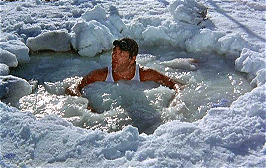
flee from the laboratory – to the Alps! In no time The Beatles’ winter sport activities are interrupted by the arrival of Foot and Algernon, intent on mayhem, to be joined almost at once by Clang and gang. After a frantic chase through snow and ice, up mountains and down ski lifts, the boys scramble to the nearest railway station and gasp to the ticket man, “London!”. Back home they confide their troubles to a Superintendent of Scotland Yard and tell him they must have protection in order to record in peace. |
 |
 |
The next day the boys record two songs on Salisbury Plain, under the protection
of the British Army, but Clang and his murderous thugs arrive and put
The Beatles to flight. Ahme, in a tank, rescues them in the nick of time.
Back in London the murder attempts increase and The Beatles decide to
leave the country until the heat is off. Heavily disguised they fly off
to the Bahamas but, alas, the world is too small a place for The Beatles,
Clang and his gang and the two power-drunk scientists.
Soon, the whole fray is resumed but Ringo learns the formula which releases
him from the ring. The ring slips off and he hands it to Clang who hastily
hands it on to Foot who tries to pass it on to Algernon and so on down
the line. Ahme and The Beatles at last find peace and the dreaded Kali
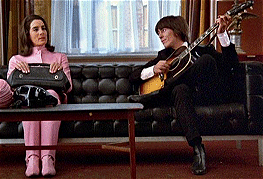
will have no more victims. The film contains numerous clever touches and colourful scenes – the four terraced houses that are really a single luxurious flat; the emergence of animated snowmen on the slopes of the ski resort; the Fab Four’s appearance as members of a brass band in uniform (very Sgt Pepperish) and the giant idol rising from the sea. One of the best sequences was filmed in the cellar of a London pub and featured Ringo and a tiger. In the film, the animal, called Sheba, has been brought up on classical music at the Berlin Zoo. To calm the beast, The Beatles have to sing ‘Ode to Joy’ from Beethoven’s Ninth. While the scene was being filmed, the film’s insurance brokers insisted that the tiger’s keeper stand close by, armed with a safari gun. |
| The
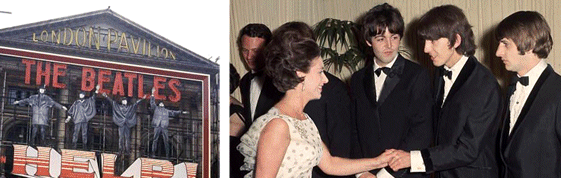
world premiere of ‘Help!’ took place at the London Pavilion on 29th July.
Crowds began to gather at 8.00am and by evening there were 10,000 people
massed in Piccadilly. The statue of Eros was boarded up for its protection
and 250 policemen were needed to handle the crowds. The area was so packed
that John’s Rolls-Royce was held up for twenty minutes. Princess Margaret and Lord Snowdon attended the event. The Princess, when talking to Ringo about ‘A Hard Day’s Night’ said, “You were a trifle pessimistic about that one. I enjoyed it very much and I have been looking forward to this one. I’ve come with an open mind”. The premiere was sponsored by the Variety Club of Great Britain in aid of the Docklands Settlement and the Variety Club’s Heart Fund. £6,000 was raised for these two charities. The film opened at 250 leading cinemas throughout the United States on 11th August and was the official British entry at the International Film Festival in Rio de Janeiro from 15-26 September, where it won first prize. The critics weren’t as universally enthusiastic about ‘Help!’ as they had been about ‘A Hard Day’s Night’, The Spectator noticed the slight stylistic influence of the Bond films (there were even a few bars of music on the soundtrack parodying the Bond music) and headed its review ‘Beatles on the Bond Trail’. |
 |
 |
The
reviewer commented: “Ringo, the oddity and outsider, in so far as any
one of them can be called that, is, as he was before, both hero and victim,
certainly the most individual character. ‘Help!’ is almost consistently
funny, sometimes almost confusingly fast, and above all a contrast to
its predecessor. Its social satire is directed inwards as much as out…The
Beatles put latchkeys into four identical front doors which, with carefully
primitive exteriors, all open into a single opulent interior, a schoolboy
millionaire’s dream of gadgets and instant marvels – sunken beds, rising
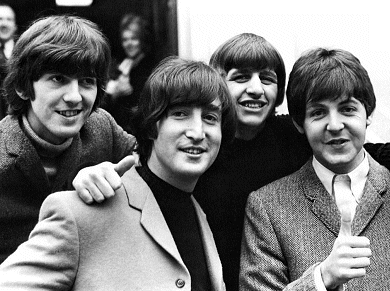
wurlitzers, orangeade-making machines and pigeon-holed sandwiches”. Writing in the Daily Express, Clive Barnes commented; “These boys are the closest thing to the Marx Brothers since the Marx Brothers”. Kenneth Tynan, in his Observer review, wrote: “The Beatles themselves are not natural actors, nor are they exuberant extroverts. Their mode is dry and laconic, as befits the flat and sceptical Liverpool accent. Realising this, Lester leaves it to his cameraman (David Watkin) to create the exuberance, confining The Beatles to dead-pan comments and never asking them to react to events with anything approaching emotion. He capitalises on their wary, guarded detachment". |
|
‘"There’s
something been in this soup’ says John, having calmly removed from the
plate a season ticket and a pair of spectacles. ‘Not a bit like Cagney’
is George’s response when a CID Superintendent favours the group with
a patronising impersonation of Ringo”.
|
 |

 |
Bill Harry attended the Liverpool College of Art with Stuart Sutcliffe and John Lennon and made the arrangements for Brian Epstein to visit The Cavern, where he saw The Beatles for the first time. Bill was a member of 'The Dissenters' and the founder and editor of 'Mersey Beat', the iconic weekly music newspaper that documented the early Sixties music scene in the Liverpool area and is possibly best known for being the first periodical to feature a local band called 'The Beatles'. He has worked as a high powered publicist, doing PR for acts such as Suzi Quatro, Free, The Arrows and Hot Chocolate and has managed press campaigns for record labels such as CBS, EMI, Polydor. Bill is the critically acclaimed author of a large number of books about The Beatles and the 60s era including 'The Beatles Who's Who', 'The Best Years of the Beatles' and the Fab Four's 'Encyclopedia' series. He has appeared on 'Good Morning America' and has received a Gold Award from the British Academy of Songwriters, Composers and Authors. |
|
Article
 Bill Harry 2014 Original
Graphics
SixtiesCity 2014
Bill Harry 2014 Original
Graphics
SixtiesCity 2014 |